
Underfloor Heating in Otago and Southland
Warm and Cool design and install hydronic underfloor heating throughout Otago and Southland — Dunedin, Queenstown, Wanaka, Alexandra, Cromwell, Invercargill and the districts around them. We pioneered air-to-water heat pump powered underfloor heating in this region and have been installing it for more than 35 years, in new builds and in existing homes.
In short
Hydronic underfloor heating circulates warm water through pipes in your floor slab, heated by an air-to-water heat pump. It warms the room from the ground up — even, draught-free radiant heat with nothing on the walls and no blown air stirring dust. Because the water only needs to be 35–45°C, it’s the most efficient way to run a heat pump. The same heat pump can heat your domestic hot water. It’s designed in before the slab is poured on a new build, and can be retrofitted to existing homes with an overlay system that raises the floor by 40–50 mm.
Why underfloor heats better than a heat pump on the wall
There are only two ways to change the temperature of a room, and understanding the difference explains almost everything about underfloor heating.
Radiant heating warms the surfaces and objects in a space — the floor, the walls, the furniture, the people — and they keep you comfortable in turn. Underfloor heating is radiant: the floor itself becomes a gentle, low-temperature heater and the warmth spreads evenly across the whole room.
Convected heating warms the air and moves it around. A wall heat pump, a ducted system, a fan coil — all condition air and blow it through the space.
For a home you live in all winter, radiant is the more comfortable way to heat. It’s even and draught-free, with no hot blast and no cold corners, and it doesn’t stir the air. Convection warms air that rises to the ceiling first, so the top of the room is warm while your feet are cold — heat stacking. Using the floor as the emitter removes that problem: the temperature is even from floor to ceiling.
What hydronic underfloor heating is
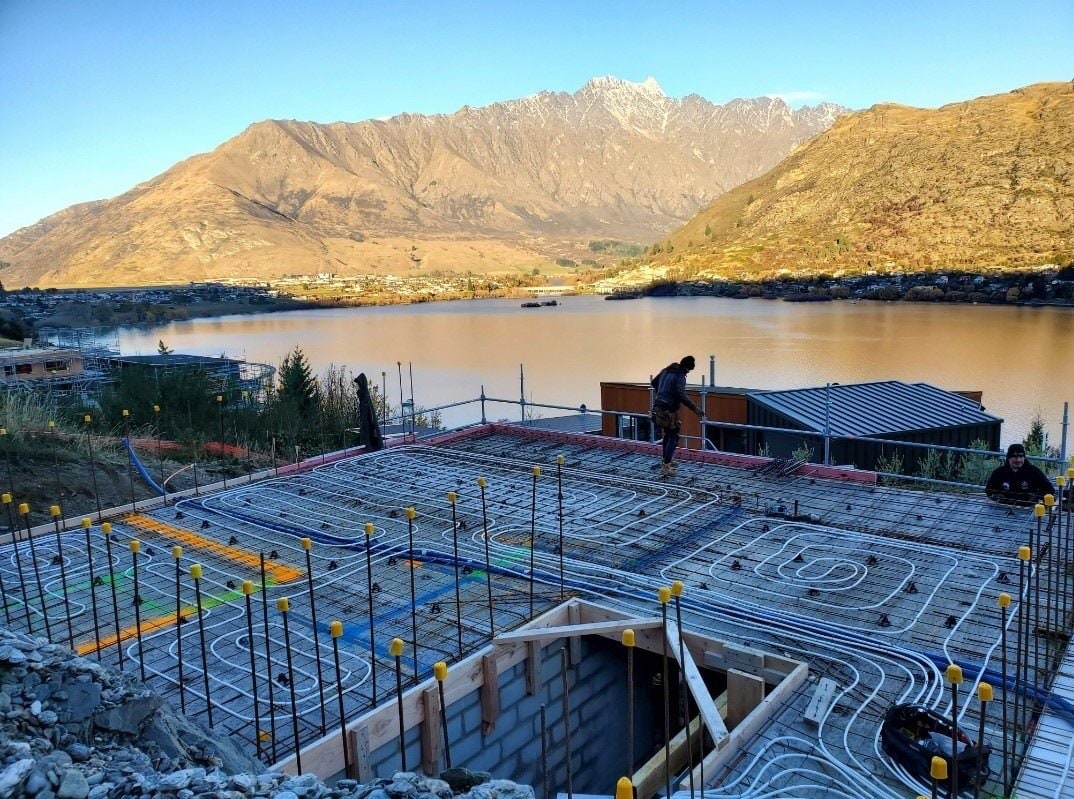
Warm water circulates through a network of pipes cast into your floor slab. Most of our customers have that water heated by an air-to-water heat pump — a Mitsubishi Electric Ecodan or a Stiebel Eltron — which sits outside much like an ordinary heat pump and runs on electricity rather than diesel, LPG or wood.
Underfloor only needs water at 35–45°C, and that is where an air-to-water heat pump is at its most efficient. It’s the combination that makes the running costs so low. Because most of New Zealand’s electricity comes from renewable sources, it’s also a considerably cleaner way to heat a home than a fossil-fuel boiler. If you’re replacing an existing boiler, that’s a conversion we do routinely.
The benefits
- Unsurpassed comfort. Even, gentle, draught-free warmth with no fan noise and no hot spots.
- Completely inconspicuous. No wall units, no radiators, nothing on show and no wall space given up to equipment. Vaulted ceilings, big runs of glass and open-plan spaces all defeat a wall-mounted heat pump; underfloor handles them quietly from the floor.
- No heat stacking. Even temperature from floor to ceiling, rather than warmth pooling above your head.
- Cleaner air. Because it doesn’t use forced air, it doesn’t circulate dust, pollen and other allergens the way a blown-air system does. That matters to anyone in the house with hay fever, asthma or allergies.
- Zone control. Each area of the house runs on its own circuit with its own thermostat, so different rooms can sit at different temperatures.
- Efficient. Low water temperatures suit a heat pump, and there’s no ductwork or fan pressure to lose heat through.
- Ideal under polished concrete. If you’re pouring a polished slab as your finished floor, the slab is both the surface you walk on and the thing doing the heating.
More than just heating the floor
A heat pump powered underfloor system is a platform, not a single-purpose appliance.
- Domestic hot water. The same heat pump can heat your hot water cylinder, typically cutting the electricity used for water heating by well over half compared with a standard electric cylinder — and hot water is roughly a third of a typical household’s power use. More on heat pump hot water
- Pools and spas. Air-to-water systems are versatile enough to be connected to heat a pool or spa.
- Summer cooling. Ceiling cassettes and floor units give instant heating or cooling independently of the underfloor system. The slab itself can also be gently reverse-cycled to take around 4–6°C off the indoor temperature in mid-summer — a subtle effect rather than air conditioning, and one that must be controlled with humidity and dew-point monitoring so condensation never forms on a cold floor.
- Radiators. Radiators can be added on the same system where underfloor isn’t possible — an upstairs level, or a room over a suspended floor.
Retrofitting underfloor heating to an existing home
Underfloor isn’t only for new builds. It can be retrofitted into existing homes with an overlay system: the floor is raised by 40–50 mm, a metal tray holds the piping, closed-cell foam insulation goes underneath, and a cement board suitable for flooring or carpet is laid on top.
t’s a more involved job than designing it into a slab, and doors and joinery need lifting to suit the new floor level, so it’s worth weighing carefully. But it’s a real option, and in the right house it’s an excellent one.
Sizing it for a southern winter
This is where systems in our region go wrong. Winters here are a long way colder than the national average, and they last longer, so we look at how cold it gets where you’re building and for how long each year, and we design for that. A system sized to a softer standard will hold a house on a mild day and leave you cold in the week you most need it.
We do a proper room-by-room heat-loss calculation every time. The heat a building loses on a cold morning is a calculable number that depends on its insulation, glazing and orientation — how well the house holds onto heat matters as much as how much heat the system can put in — and that number, not a rule of thumb per square metre, drives the specification. It also drives the pipe spacing and the number of circuits, which is why the design has to be settled before the slab goes down.
Talk to us before the slab is poured
If you’re building, this is a design-stage decision. Once the slab is down your options narrow sharply, and retrofitting later costs considerably more than designing it in.
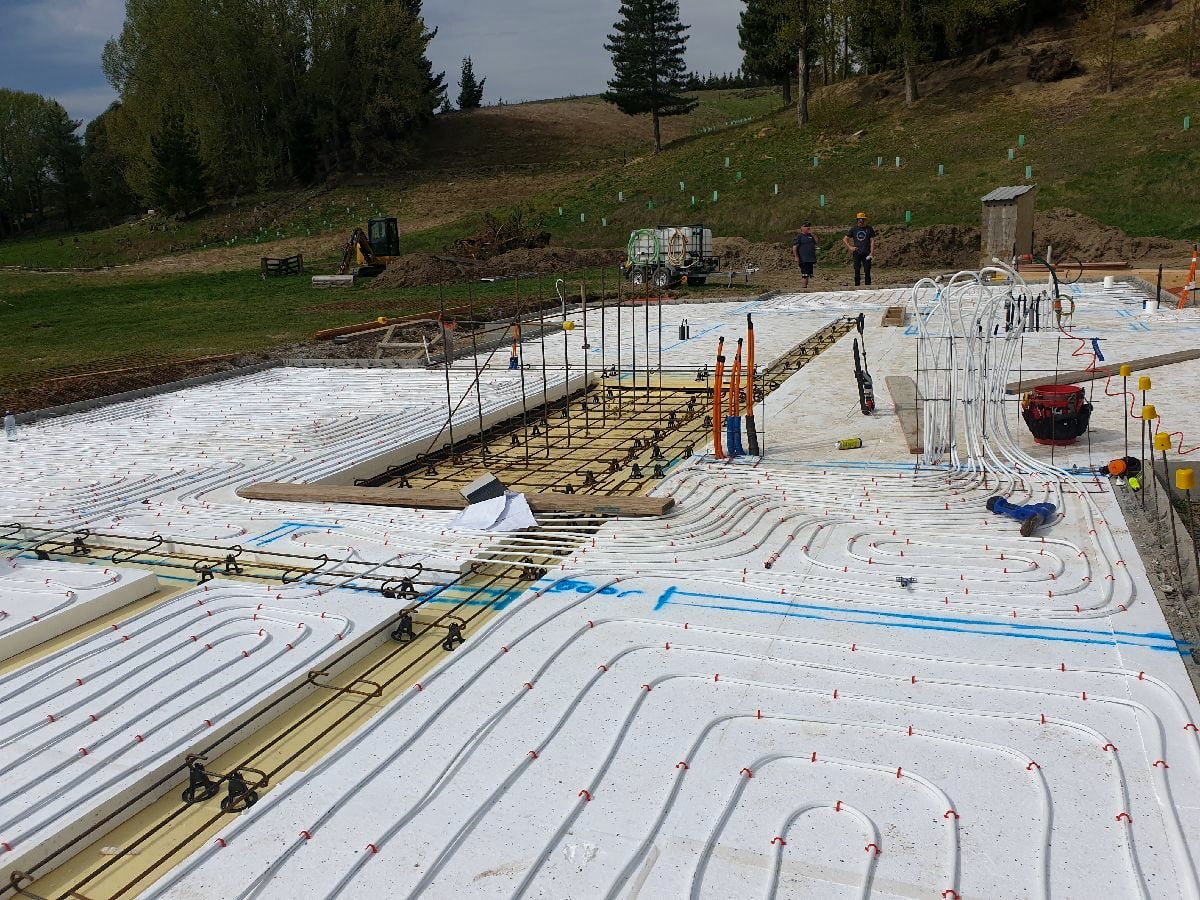
We’d prefer to be at the table alongside your architect and builder than brought in once the plans are locked. Early involvement lets us work out where the equipment can sensibly live, set out the pipe penetrations and floor sensors before the pour, make sure the slab is insulated underneath and at its edges as a heated slab now has to be, and read the thermal properties of the home — insulation, glazing and orientation — so the system is designed for that house.
One thing worth saying to anyone mid-build: heating is the thing you can’t see, so it’s often first to be trimmed when the budget gets pulled in every direction. But it’s what decides how the finished home actually feels to live in through a long southern winter.
Underfloor heating for a Central Otago new build — and how cooling fits in
What it costs
Hydronic underfloor heating with an air-to-water heat pump for a typical new home usually lands somewhere between $40,000 and $70,000 including GST, with smaller homes starting from around $30,000. Larger homes, two levels, more zones and a warmed garage take it to $80,000 and beyond. A retrofit overlay system is priced individually, because it depends so much on the house.
What moves the number: floor area, number of zones, the level of insulation, the heat pump size the heat-loss calculation calls for, whether radiators or hot water are added, and access.
We quote a fixed price for the finished system, with the full scope set out — every item of equipment, every part of the installation, and everything included and excluded.
Where we work
Warm and Cool are based in Dunedin and install underfloor heating throughout Otago and Southland — Dunedin, Mosgiel, Oamaru, Balclutha, Gore, Invercargill, Queenstown, Arrowtown, Wanaka, Alexandra, Cromwell and the surrounding districts. We work regularly with builders, architects and designers across the region.
Ready to talk about underfloor heating?
Whether you’re at design stage on a new build or weighing up a retrofit, the right place to start is a conversation about your home.
Frequently asked questions
Is underfloor heating worth it in Otago and Southland?
For most new builds on a concrete slab, yes. It delivers even, draught-free radiant warmth that suits long southern winters, it’s invisible, it’s ideal under polished concrete, and because it doesn’t blow air around it’s cleaner for anyone with allergies or asthma. The same air-to-water heat pump can heat your domestic hot water too. The main trade-offs are a higher upfront cost than wall units and a slow response, so it’s designed to run steadily rather than being turned up and down.
How much does underfloor heating cost in New Zealand?
Ballpark, $40,000 to $70,000 including GST for a typical new home in Otago or Southland, from around $30,000 for a compact one, and $80,000-plus for a large or two-level home. Warm and Cool quote a fixed price with the full scope written out.
Can underfloor heating be retrofitted into an existing home?
Yes, using an overlay system. The floor is raised by 40–50 mm, a metal tray carries the piping with closed-cell foam insulation beneath, and a cement board suitable for flooring or carpet goes on top. Doors and joinery need lifting to suit the new level, so it’s a more involved job than designing it into a slab — but in the right house it works very well.
Does a heated slab need insulation underneath?
Yes. Without insulation under and around the edge of the slab, a large share of the heat goes into the ground instead of the house, and the New Zealand Building Code now requires heated slabs to be insulated. It has to be designed in before the pour, which is one of the reasons we ask to be involved early.
Does underfloor heating cool the house in summer?
Its main job is heating, but the same hydronic slab can be reverse-cycled to gently chill the floor in summer, taking around 4–6°C off the indoor temperature. It’s a subtle effect rather than the blast of an air conditioner, it’s run seasonally rather than switched on and off, and it must be controlled with humidity and dew-point monitoring so condensation never forms. For stronger cooling, ceiling cassettes, floor units or a ducted system are added alongside.
Underfloor heating or heat pumps — which is better?
It isn’t really either/or, because hydronic underfloor is itself driven by a heat pump — an air-to-water one. Radiant is the more comfortable way to heat and moving air is the better way to cool, so the best result in a southern home is usually underfloor for winter warmth paired with a discreet ducted system or heat pumps for summer cooling.
Is underfloor heating expensive to run?
Running cost depends far more on your home’s insulation, glazing and how warm you keep it than on the emitter itself. What underfloor does well is run at low water temperatures — 35–45°C — which is where an air-to-water heat pump is most efficient. Having the same heat pump heat your domestic hot water, roughly a third of a typical household’s electricity use, improves the economics further.
How long does underfloor heating take to warm up?
Hours, and from stone cold a day or more. The thermal mass of the slab that gives you such steady, even warmth also means it can’t be turned up when you feel cold. It’s designed to run continuously or on a gentle setback through the heating season rather than being switched on and off — a different way of thinking about heating, and one most people find they prefer once they’ve lived with it.


