
Boiler to Heat Pump Conversion in Otago and Southland

Warm and Cool convert diesel, LPG, coal, wood and wood-pellet boilers to air-to-water heat pumps across Otago and Southland — keeping your existing radiators or underfloor heating and replacing the plant that drives them. We’re based in Dunedin, and we’ve been designing and installing heating in the lower South Island since 1990.
In short
A boiler conversion replaces your boiler with an air-to-water heat pump — the outdoor unit heats water instead of air — along with the pumps, controls and usually the hot water arrangement, while keeping your radiators or underfloor loops. In Otago and Southland a full conversion typically costs $25,000–$50,000 including GST, and we quote a fixed price after measuring your system.
Why people are converting
It used to be that a conversion happened when a boiler failed. Increasingly it isn’t. We’ve replaced boilers that were nearly new, simply because the cost of feeding them had become punishing.
The reason is the efficiency gap, and it’s larger than most people expect. A boiler — whatever it burns — runs at somewhere between 40% and 80% efficiency. You never get back more energy than you put in, because some of it goes up the flue. A heat pump doesn’t make heat, it moves it, delivering roughly 200% to 500% of the energy it draws depending on the model, the outdoor temperature and the water temperature it’s asked to produce.
Then there’s everything that disappears alongside the boiler: diesel and LPG delivery charges, bottle and tank rental, and the ordering, storing and handling of fuel. A 45 kg LPG bottle doesn’t last long feeding central heating. Lines charges in Otago have also risen sharply, which makes the running-cost case stronger, not weaker.
The second reason we hear regularly is getting off fossil fuels. With most of New Zealand’s electricity generated from renewable sources, a heat pump isn’t only cheaper to run — it’s a considerably cleaner way to heat a house.
What a conversion actually involves
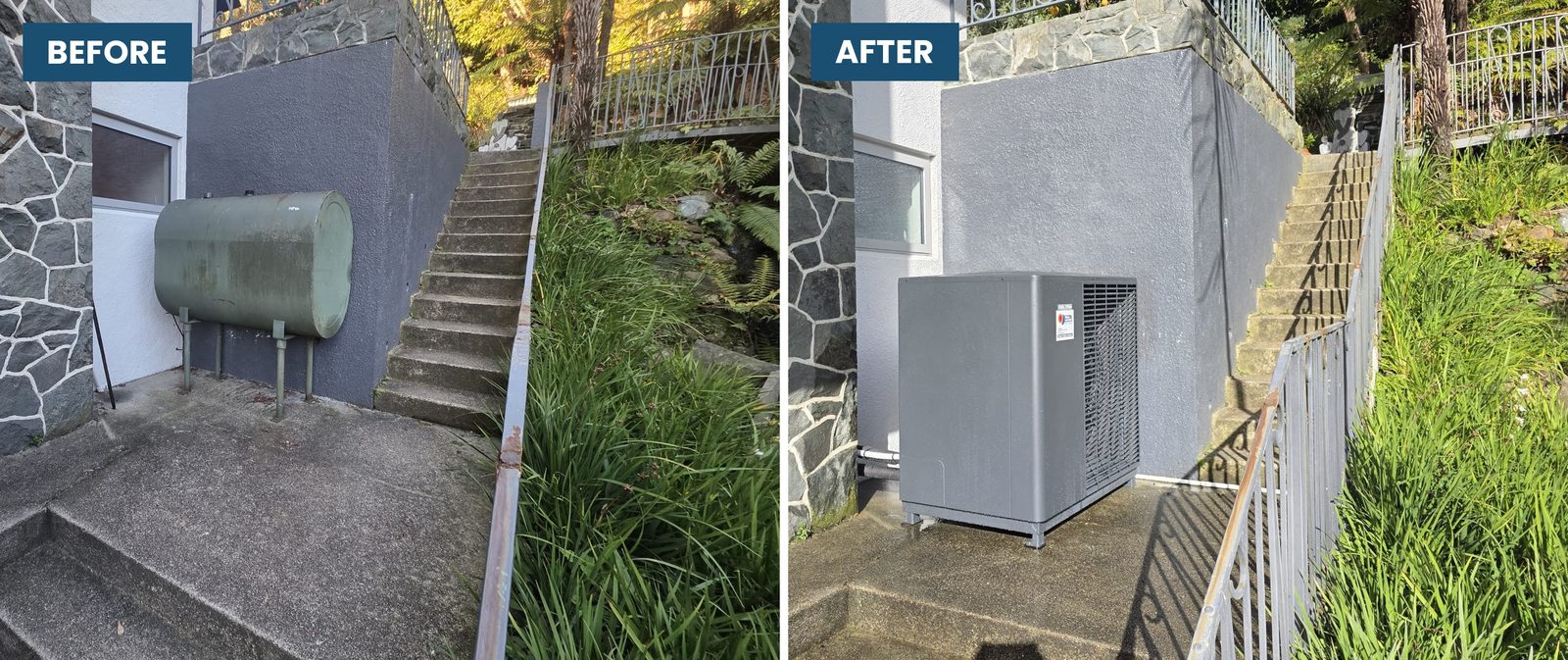
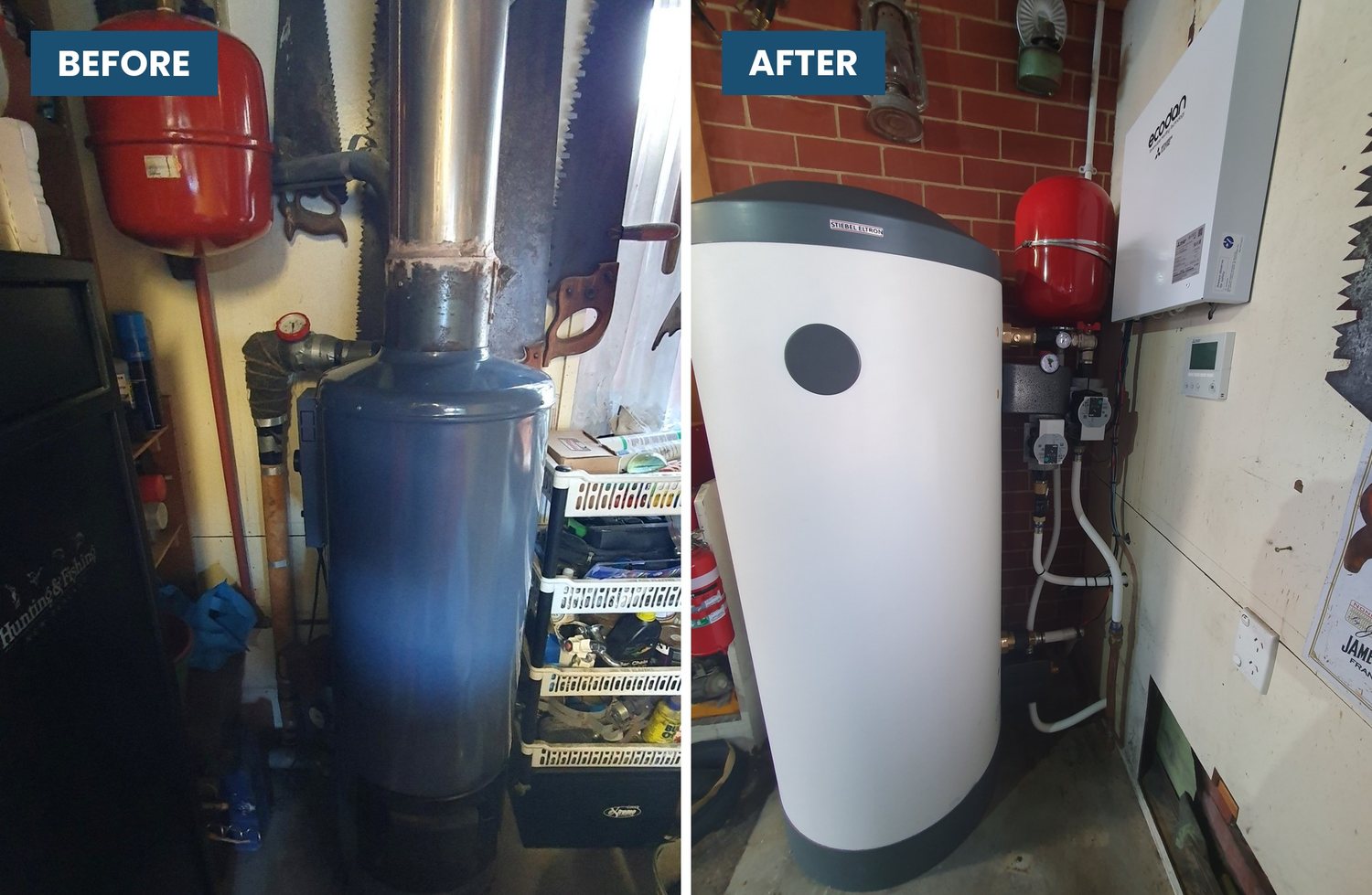
Think of it as replacing the plant while keeping the distribution. Your radiators, underfloor loops and most of your pipework stay. What changes is everything that generates and moves the heat:
- The heat source — an air-to-water heat pump outside, replacing the boiler. Not to be confused with a hot water heat pump, which only heats a domestic cylinder (see the FAQ below).
- Hydraulic separation — usually a buffer tank, which boiler systems rarely have. A heat pump needs a minimum volume of water to work against so it doesn’t short-cycle, and the buffer also lets the heat pump defrost itself in winter without pulling heat back out of your radiators.
- Circulating pumps — the primary circuit from the heat pump and the heating circuit that feeds your emitters.
- Controls — sometimes the existing thermostats carry over; often a conversion is the right moment to move to proper zone control.
- Hot water — if the boiler heated your cylinder, that has to be re-provided, either off the same heat pump or with a separate hot water heat pump.
- The old plant — boiler, flue, and fuel tank or bottles removed and taken away.
- It’s a heating system replacement that happens to reuse the radiators, which is why it costs what it costs.
Will my existing radiators work?
Often, yes.
Boilers run anywhere between 50°C and 80°C. A standard air-to-water heat pump is designed to run at up to 55°C, and a high-temperature model at 60–65°C — some will go higher, but efficiency falls the hotter the water is asked to be. This matters because a radiator’s output depends on how much hotter it is than the room: drop the flow temperature from 75°C to 55°C and a radiator’s output roughly halves.
So on every conversion assessment we establish what your system is actually running at. Where it helps, we use thermal imaging to see which radiators are performing and which have been quietly under-delivering for years. Anyone who tells you your radiators will be fine without having measured is guessing.
One reassurance for older homes: cast-iron radiators were usually generously sized for their rooms, so they often still have enough output at heat-pump temperatures. We frequently keep them.
Our full guide goes through the flow temperature question, a free test you can run yourself before you commit, and the three paths from there. Read the full guide.
Sizing for a southern winter
This is where conversions in our region go wrong, and it’s worth understanding before you compare quotes.
A heat pump’s headline capacity is measured at an outdoor temperature of +7°C. That is not a Central Otago winter morning. Output falls as the air gets colder — exactly when your house needs more — and in damp cold most heat pumps lose a further 10–15% to defrost cycles. Units built for cold climates hold their output far better through that band.
We design for the coldest temperatures your area typically sees — how cold it gets where you live, and for how long each winter — not for a national average. A unit is only selected once we’ve confirmed its published output in those conditions and at the water temperature your radiators need.
We don't design for the lowest temperature your area has ever recorded. The cost of covering that is prohibitive, because it happens for only a handful of hours a year. Good practice is to design to a more achievable and economic number - enough to hold the house comfortably through all but the very coldest mornings of a hard winter - and to let the system's backup element cover those few hours, rather than sell you more heat pump than the house needs.
The other half of the equation is the house itself. What keeps you warm is how quickly the system can put heat in against how well the home holds onto it — the insulation, the glazing, the draughts. Two houses the same size can need very different systems, which is why we measure yours rather than size from the floor area.
It also matters which unit you start from. We work mainly with Mitsubishi Electric and Stiebel Eltron because both build for cold weather, and in our region we specify the units that perform better in the cold and, where older radiators need it, can supply higher water temperatures. A heat pump that fades at −5°C is no use in Alexandra.
What a proper conversion includes
If you’re comparing quotes and one is dramatically lower, these are usually what’s missing:
- Cleaning and treating the system water. Decades-old boiler systems carry sludge and corrosion products that will wreck a heat pump’s plate heat exchanger. A conversion needs a chemical clean, a flush, a magnetic filter, and inhibitor dosed to the measured volume of your system.
- A check valve on radiator systems, so heat doesn’t thermosiphon around the circuit when the system is meant to be off.
- The electrical supply check. A heat pump adds significant load. What matters is the rating of your main switch and incoming supply — some older homes need an upgrade, and that’s far better found during quoting than mid-installation.
- Condensate management, so winter condensate is taken away properly rather than freezing where people walk.
- Removal and disposal of the old plant, including decommissioning LPG bottles or capping a reticulated supply.
- Commissioning — setting up, balancing, proving every zone reaches temperature, and showing you how to run it.
What it costs
We quote a fixed price for the finished system, with the full scope set out in the quotation — every item of equipment, every part of the installation, and everything included and excluded. You’ll know exactly what you’re getting and what it costs. What you won’t get is an estimate with a range attached, or a number that moves once we start.
| Scope | Typical cost (incl GST) |
|---|---|
| Heat pump replacing an existing air-to-water unit, system otherwise sound | from around $20,000 |
| Full boiler conversion onto existing radiators or underfloor | $25,000–$50,000 |
| Conversion including domestic hot water off the same system | toward the upper end |
| Large homes, staged installations, or significant radiator work | priced individually |
One practical note before ruling anything out on cost: several banks now offer low or no-interest loans for home energy-efficiency work, and a heating upgrade usually qualifies. It’s worth a conversation with yours.
Where we work
Warm and Cool are based in Dunedin and convert boilers throughout Otago and Southland — Dunedin, Mosgiel, Oamaru, Balclutha, Gore, Invercargill, Queenstown, Arrowtown, Wanaka, Alexandra, Cromwell and the surrounding districts. Every one of those places gets a different winter and has its own practical constraints, which is a large part of why we size each job individually.
Why Warm and Cool
- More than 35 years in heating across Otago and Southland, with more than 2,000 customers
- Conversions from diesel, LPG, coal, wood, wood-pellet and electric-element boilers
- We measure rather than assume — flow temperature, water volume, electrical supply and heat loss, every time
- Authorised Mitsubishi Electric installers, and we work with Stiebel Eltron for cold-climate air-to-water
- Fixed-price quotes with the full scope written out
- We coordinate the whole project — our own team and electrician, and the plumber where one is needed. You’re not managing trades.
Get a fixed-price quote
The only way to price a conversion properly is to come and measure the system you’ve got. There’s no obligation.
Frequently asked questions
How much does it cost to convert a boiler to a heat pump in Otago or Southland?
A full conversion onto existing radiators or underfloor heating typically costs between $25,000 and $50,000 including GST. Replacing an existing air-to-water heat pump where the rest of the system is sound generally starts from around $20,000. Warm and Cool quote a fixed price with the full scope set out after a site assessment.
How long does a boiler to heat pump conversion take?
The installation itself takes your heating offline for the changeover, and hot water is off for at least a working day if the cylinder is being replaced — we confirm which days are affected before we start. The full project from first enquiry to a working system is usually measured in weeks rather than days, because design, equipment lead times and scheduling sit ahead of installation day. Demand climbs steeply as winter approaches, so there’s a real advantage in starting the conversation in spring or summer.
Can I keep my existing radiators after converting to a heat pump?
Often, yes, but it depends on the temperature your system needs to run at. Boilers are set between 50°C and 80°C; a standard air-to-water heat pump runs at up to 55°C and a high-temperature model at 60–65°C, and a radiator’s output roughly halves between 75°C and 55°C. We measure your system’s actual flow temperature before advising. Cast-iron radiators are frequently kept because they were generously sized to begin with.
What’s the difference between an air-to-water heat pump and a hot water heat pump?
An air-to-water heat pump is the heart of a hydronic heating system: it heats the water that circulates through your radiators or underfloor pipes, and it can heat your domestic hot water cylinder as well. A hot water heat pump only heats a domestic cylinder — it can’t run central heating. A boiler conversion is always an air-to-water heat pump job.
Is a heat pump cheaper to run than a diesel, LPG or wood boiler?
For most homes, yes, and the gap is large. A boiler runs at roughly 40% to 80% efficiency because it burns fuel to make heat. A heat pump moves heat instead, delivering around 200% to 500% of the energy it draws depending on the model, the outdoor temperature and the water temperature required. There’s also no fuel to order, store or handle, and delivery charges and bottle or tank rental disappear. The exact saving depends on your electricity tariff and how the system is run.
Can I keep my old boiler as a backup?
Often, and sometimes it’s the sensible choice — most commonly with wood or coal gasification boilers where you have ready access to firewood. The heat pump goes in alongside it and generally becomes the primary heat source over time, with the boiler available when you want it.
Do you convert gas boilers?
Yes, though “gas boiler” means something different here. New Zealand’s natural gas network is confined to the North Island, so most boilers in Otago and Southland run on diesel, bottled or tanked LPG, or wood. Some Queenstown-area subdivisions — Lake Hayes Estate and Millbrook among them — do have reticulated gas. The conversion follows the same path either way; what differs is how the old fuel supply is decommissioned.
Which areas do you cover?
Warm and Cool are based in Dunedin and work throughout Otago and Southland, including Mosgiel, Oamaru, Balclutha, Gore, Invercargill, Queenstown, Arrowtown, Wanaka, Alexandra and Cromwell.


