
Diesel, LPG or Wood Boiler to Heat Pump Conversion in Otago and Southland: What It Really Costs
By Warm and Cool | Last updated: 26 August 2026 Serving Dunedin, Queenstown, Otago and Southland
Quick answer
Converting a diesel, LPG or wood boiler to an air-to-water heat pump, keeping your existing radiators or underfloor heating, typically costs somewhere between $25,000 and $50,000 including GST in Otago and Southland. Smaller jobs come in under that, and large or staged installations can run beyond it.
That is more than most online estimates suggest, and the reason is straightforward: this is not a boiler swap. The boiler is one component in a heating system, and a proper conversion replaces the heat source, the pumps and controls that go with it, and usually the hot water arrangement as well.
The single factor that decides whether a conversion works well is the temperature your existing radiators or underfloor need to run at. That is a measurement, not an assumption, and it is the first thing we check.
What “gas boiler” actually means down here
New Zealand’s natural gas transmission network is confined to the North Island, so most articles about converting a “gas boiler” describe a mains-gas job that does not exist in this part of the country. Down here a boiler is usually running on diesel, bottled or tanked LPG, or wood.
There are exceptions worth knowing about. A number of Queenstown-area subdivisions have reticulated gas piped to the house — Lake Hayes Estate and Millbrook Estate among them — so if you live in one of those, you may well have a piped supply and a genuine gas boiler or gas-fired central heating. It is not widespread, but it is not rare either, and it changes the details of the changeover.
Either way, the conversion itself follows the same path. What differs is what happens to the old fuel supply: a diesel installation means dealing with the tank and the fuel line, LPG bottles or a tank have to be decommissioned and returned, and a reticulated supply needs capping off properly at the point of entry. All of it is straightforward — it just needs to be in the quote rather than discovered on the day.
A 45 kg LPG bottle runs somewhere around $170 to $180, and it does not last long feeding central heating — which is a large part of why gas-fired central heating gets expensive so quickly down here.
The other thing worth saying plainly: diesel and LPG both carry delivery charges, and bottled and tanked LPG carry rental as well. Those are costs that disappear entirely with a heat pump, and they are easy to forget when you are comparing fuel prices alone.
Why the running cost changes so much
This is the number that surprises people, and it is worth understanding rather than taking on trust.
A boiler — whatever it burns — runs at somewhere between about 40% and 80% efficiency. You never get back more energy than you put in; some of it goes up the flue. That is simply how burning fuel works.
A heat pump plays a different game entirely, delivering roughly 200% to 500% — two to five times the energy it draws — depending on the model, the conditions and how the system is set up. That is not a misprint. A heat pump does not make heat, it moves heat from the outside air into your water, and moving heat costs far less energy than creating it.
That gap is the whole reason these conversions happen. Increasingly the trigger is not a boiler that has failed at all — we have replaced boilers that were nearly new, simply because the cost of feeding them had become punishing. Most boilers give 15 to 25 years, but running cost now brings the decision forward more often than age does.
There is a second motivation that comes up regularly: moving off fossil fuels. In New Zealand that argument holds up, because our electricity is generated largely from renewable sources. A heat pump is not just cheaper to run, it is a considerably cleaner way to heat a house.
What actually gets replaced
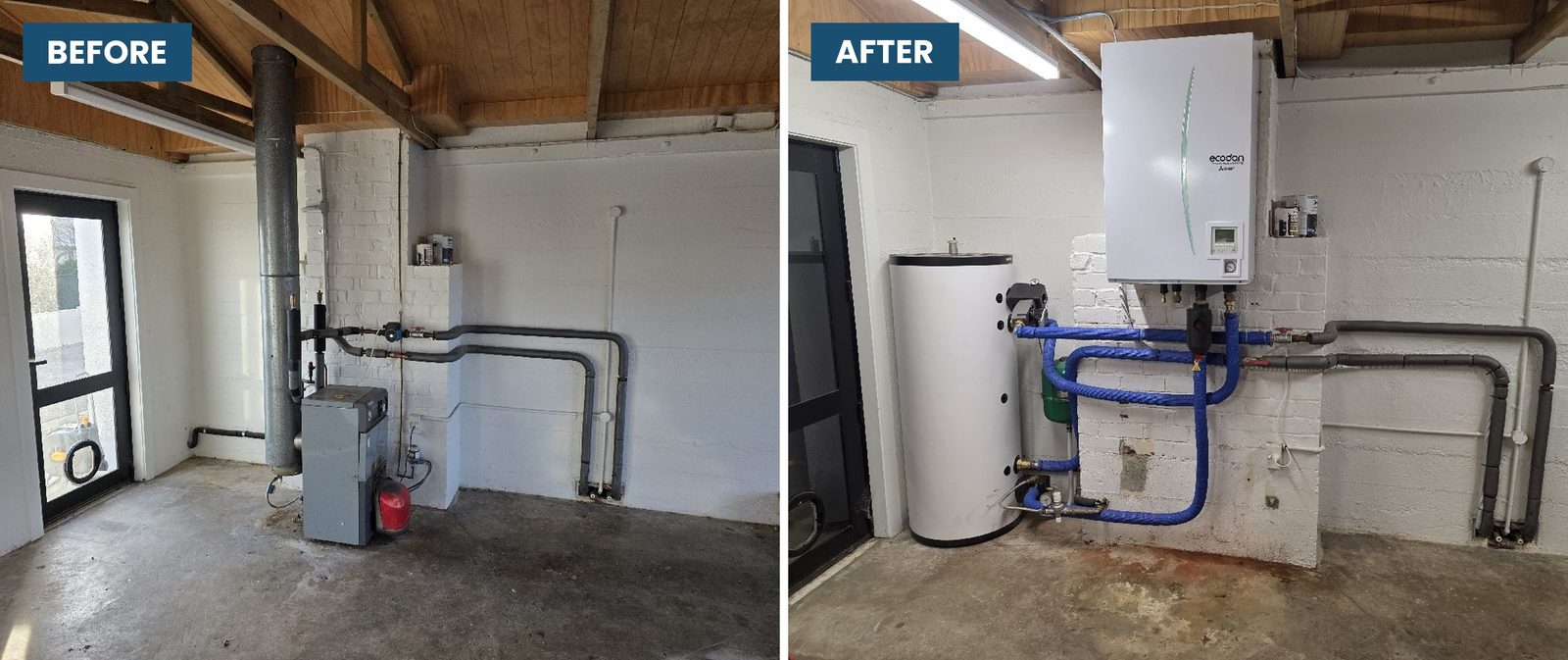
A conversion is best thought of as replacing the plant while keeping the distribution. Your radiators, underfloor loops and most of the pipework stay. What changes is everything that generates and moves the heat:
- The heat source — an air-to-water heat pump, sited outside, replacing the boiler.
- The hydraulic arrangement — typically a buffer tank or hydraulic separator, which a boiler system usually does not have. Heat pumps need a minimum water volume to run without short-cycling.
- Circulating pumps — the primary circuit between the heat pump and the buffer, and the heating circuit that feeds your emitters.
- Controls — sometimes the existing controls carry over, sometimes they do not. Either way a conversion is the natural moment to upgrade them (see below).
- Hot water — if the boiler heated your cylinder, that has to be re-provided, and often the cylinder itself is replaced.
- The old plant — the boiler, flue, and fuel tank or bottles removed and taken away.
Seen that way, the cost makes sense. You are buying a new heating system that happens to reuse the radiators.
Controls — usually the best-value part of the whole job
Some existing controls transfer across perfectly well. Others do not, either because they are wired for a boiler’s on-off, short-burst behaviour, or simply because they are old and awkward. We will tell you which yours are.
But even where the old controls could stay, a conversion is the sensible moment to change them, because the cost of doing it while everything is already open is small compared with the difference it makes day to day:
- Controls people can actually use. A lot of the heating systems we are called out to are not underperforming at all — they are simply set up in a way nobody in the house understands. A clear thermostat with a sensible schedule fixes more comfort complaints than any amount of extra capacity.
- Wi-Fi and app control. Being able to adjust the heating from your phone is genuinely useful on a system that runs steadily rather than in bursts — turning things up before you drive home from the lake, dropping it back when the house empties, or checking on it from away. It also lets us help you remotely if something needs adjusting.
- Room-by-room control, where the layout justifies it, so you are not heating bedrooms all day.
Note that app control is available on the heating side. Air-to-water heat pumps in New Zealand do not currently come with a manufacturer’s app of their own, so the remote control comes through the heating controls we fit rather than the heat pump itself. We will show you exactly what it does before you decide.
The flow temperature question — this decides everything
Boilers are set anywhere between 50°C and 80°C, and where yours sits matters enormously. Plenty of systems we look at are running at 70°C or more; plenty of others are already sitting at 55 or 60 and heating the house perfectly well. You cannot tell from the outside, which is the whole point.
A standard air-to-water heat pump is most efficient at 50–55°C. High-temperature models — the Mitsubishi Ecodan high-temperature range and the Stiebel Eltron WPL-A among them — are rated higher again, but 60–65°C is the realistic band to design and run them at, and that is the figure we work to rather than the number on the badge.
This matters because a radiator’s heat output depends on how much hotter it is than the room. Drop a radiator’s flow temperature from 75°C to 50°C and its output falls by roughly half. A radiator that comfortably heated a room on a boiler may not do so on a standard heat pump.
A test you can run yourself, for free
If your boiler is set above 60°C, turn it down to 60 and live with it for a week or two of cold weather.
The system will take longer to bring the house up, and that is expected — heat pumps work by running longer and steadier rather than in short hot bursts, so this is a fair preview of how the house will behave. What you are looking for is whether those longer runs still get you to a comfortable temperature in the rooms you care about.
If the answer is yes, your radiators are very likely to work on a heat pump. If some rooms never quite get there, you have just identified exactly which ones need attention — which is genuinely useful information, and it costs you nothing to find out.
So we measure it. We do not assume it. On every conversion assessment we establish what your system is actually running at — not what the boiler’s dial says, and not a figure copied from a similar house. Where it helps, we use thermal imaging to see which radiators are genuinely performing and which have been quietly under-delivering for years.
Once that measurement is in hand, there are three honest paths:
- A high-temperature heat pump, which keeps your existing radiators as they are. Costs more up front, and runs a little less efficiently than a low-temperature system.
- Upsize the radiators in the rooms that need it, and run a standard heat pump at lower temperatures. Better long-term efficiency, more disruption during installation.
- A combination — a high-temperature unit plus a small number of radiator changes in the worst rooms.
Anyone who tells you your radiators will be fine without having measured the system is guessing.
One reassurance for older homes: heavy old cast-iron radiators are often better candidates than people expect. Their mass means they radiate steadily and give up their heat happily at lower temperatures, which suits the way a heat pump runs. They are frequently kept.
Keeping the old boiler as backup
Not every conversion means the boiler leaves.
Where a home has a wood or coal gasification boiler and the owner has ready access to firewood, it can make good sense to keep it in play and add the heat pump alongside it. The heat pump goes in nominally as backup — and then, in most cases, quietly becomes the primary source over time.
That suits a particular situation well: someone who genuinely does not mind loading a fire today, but can see that chopping, carting and loading is going to get less appealing, or less practical, as the years go on. You keep the option and the fuel you already have, without staying chained to the chore. If the day comes when nobody wants to light it, the heat pump is already doing the work.
Sizing for a Southern winter — never on the nameplate
This is where conversions in our region go wrong, and it is worth understanding before you compare quotes.
A heat pump’s headline capacity — the “14 kW” on the box — is measured at an outdoor temperature of +7°C. That is not a Central Otago winter morning. As the outside air gets colder, the heat pump produces less heat, exactly when your house needs more. On top of that, every heat pump spends part of its time defrosting, which costs a further 10–15% of output through the coldest part of the season.
We design to the coldest conditions your part of the region actually sees - not just how cold it gets, but how long it stays there each winter. Inland Central Otago is a different problem from coastal Dunedin, and the Mackenzie is different again.
We don't design for the lowest temperature your area has ever recorded. The cost of covering that is prohibitive, because it happens for only a handful of hours a year. Good practice is to design to a more achievable and economic number - enough to hold the house comfortably through all but the very coldest mornings of a hard winter - and to let the system's backup element cover those few hours, rather than sell you more heat pump than the house needs.
The other half of the question is the house itself. How quickly we can put heat in is only one side of it; how well the building holds onto that heat - insulation, glazing, draughts - decides how much heat you need in the first place. Two identical-looking houses in the same street can need very different systems, and we look at both sides before a unit is chosen.
A unit is only selected once we have confirmed its output in those conditions, with the defrost allowance applied. Undersizing is the real risk in this part of the country: an undersized system will hold the house on a mild day and leave you cold on the week you most need it, and by then the only fix is a new heat pump.
It also matters which unit you start from. We work mainly with Mitsubishi Electric and Stiebel Eltron because both build genuinely for cold weather — Mitsubishi’s Zubadan range is engineered to hold its output as the temperature drops, and Stiebel’s German-built units are designed for the same conditions. Not every air-to-water heat pump on the market is. One that fades at −5°C is no use in Alexandra.
What a proper conversion includes that a cheap quote won’t
If you are comparing quotes and one is dramatically lower, these are usually the items missing:
- Cleaning and treating the system water. Boiler systems that have run for decades carry sludge and corrosion products. That debris will wreck a heat pump’s plate heat exchanger. A conversion should include a chemical clean, flushing, and a corrosion inhibitor dosed to the measured water volume of your system.
- A check valve on radiator systems. Without one, heat migrates around the circuit by natural convection when the system is meant to be off — rooms warm up on their own and the system fights itself.
- The electrical supply check. A heat pump adds significant electrical load. What matters is the rating of your main switch and incoming supply, not the label on the switchboard. Some older homes need a supply upgrade, and it is far better to find that out during quoting than mid-installation.
- Condensate management. Air-to-water units produce condensate in winter and it has to be taken away properly, or it freezes where people walk.
- Removing and disposing of the old plant. One thing to plan for: a diesel tank must be completely empty before we can take it away. If yours has fuel in it, run it down over the weeks before the changeover, or arrange for the remainder to be uplifted. It is the single most common thing that holds up an otherwise tidy removal.
- Commissioning — setting the system up, balancing it, proving it reaches temperature in every zone, and showing you how to run it.
Hot water — the part that gets overlooked
If your boiler also heated your hot water cylinder, the new system has to cover that too. Most air-to-water heat pumps can, but there is a consequence worth knowing: while the unit is heating the cylinder, it is not heating the house. On a cold morning with a large cylinder, that pause is noticeable.
The options are to size the heat pump with enough capacity in hand to absorb the interruption, to fit a separate hot water heat pump, or to accept the pause and schedule cylinder recovery outside peak heating hours. Which is right depends on your household, and it should be a decision you make deliberately rather than one you discover afterwards.
What it costs, and what moves the number
Based on the conversions we have quoted and installed across Otago and Southland:
| Scope | Typical cost (incl GST) |
|---|---|
| Heat pump replacing an existing air-to-water unit, system otherwise sound | from around $20,000 |
| Full boiler conversion onto existing radiators or underfloor | $25,000 – $50,000 |
| Conversion including domestic hot water off the same system | toward the upper end |
| Large homes, staged installations, or significant radiator work | priced individually |
The things that move the number most:
- Whether a standard or high-temperature heat pump is needed — decided by the flow temperature measurement.
- Whether hot water comes off the same system, and whether the cylinder is being replaced.
- How much of the existing distribution can stay — radiator changes add cost quickly.
- The electrical supply, and whether an upgrade is required.
- Access and siting — where the outdoor unit can go, and how far it is from the plant space.
We quote a fixed price for the finished system, with the full scope of work set out in the quotation — every item of equipment, every part of the installation, and everything included and excluded. You will know exactly what you are getting and what it costs. What you will not get is an estimate with a price range attached, or a number that moves once we start.
One practical note before you rule anything out on cost: plenty of homeowners fund a heating upgrade through a low or no-interest loan from their bank, which several now offer for efficiency work. It is worth a conversation with yours before assuming the better long-term option is out of reach.
One question worth answering now rather than later: are you planning to extend the house? If a renovation is going to add heated floor area, it is far better to allow for it at the design stage than to discover it afterwards. The fix is not a small retrofit — it is either sizing the heat source larger up front, or adding a second unit later, and both cost considerably more as an afterthought.
Why we do these entirely with heat pumps
Worth being upfront about how we work: we have not installed a new boiler in over four years. We now do these conversions exclusively with heat pumps, in homes and commercial buildings alike, because that is what delivers the best long-term result.
We do dozens of conversions a year and have done for many years, across diesel, LPG, coal, wood, wood pellet and electric-element systems. That volume matters, because most of what goes wrong on a conversion is not exotic — it is the system water, the flow temperature, the electrical supply and the hot water arrangement, and knowing where each of those bites comes from having done it repeatedly.
Plenty of people are quite fond of their boiler, and that is fair enough. A good diesel or LPG boiler heats a house well, and indoors it is clean — no smell, no fumes. The problem is simply what it costs to feed, and that burning fuel to heat a house is no longer the sensible way to do it.
What the installation is like to live through
The part most people want to know: your heating will be off while the changeover happens, and your hot water will be off for at least a working day if the cylinder is being replaced. We plan conversions to keep that window as short as we can, and we will tell you before we start exactly which days are affected.
The full timeline from first enquiry to a working system is usually measured in weeks rather than days, because design, equipment lead times and scheduling all sit ahead of installation day. Demand climbs steeply as winter approaches, so there is a real advantage in starting the conversation in spring or summer.
Frequently asked questions
How much does it cost to convert a boiler to a heat pump in Otago or Southland?
A full conversion onto existing radiators or underfloor heating typically costs somewhere between $25,000 and $50,000 including GST. Replacing an existing air-to-water heat pump where the rest of the system is sound generally starts lower, from around $20,000. Every home is different, so a site assessment and a fixed-price quotation with the full scope set out are what give you the real figure.
Why is that more than other estimates I have seen online?
Because a conversion replaces a complete heating plant, not just the boiler. Alongside the heat pump itself, the job normally includes a buffer tank or hydraulic separator, new circulating pumps, new controls, a full system clean and water treatment, the hot water arrangement, electrical work, and removal of the old boiler and fuel tank. Estimates in the $5,000 to $15,000 range generally describe a straight like-for-like swap, which is not what a boiler conversion is.
Can I keep my existing radiators?
Often, but it depends on the temperature your system needs to run at. Boilers are set anywhere between 50°C and 80°C, while a standard heat pump runs at 50–55°C, and a radiator’s output falls by roughly half between 75°C and 50°C. A high-temperature heat pump run at 60–65°C will usually keep existing radiators working as they are. We measure your system’s actual flow temperature before advising, rather than assuming it.
What size heat pump do I need?
More than the nameplate rating suggests. Capacity is quoted at an outdoor temperature of +7°C, and output falls as it gets colder — with a further 10-15% lost to defrost cycles. We size to the coldest conditions your area typically sees and how long they last, and we confirm the unit's output in those conditions before specifying it. How well the house holds heat matters just as much as how much heat we can put in.
Is a heat pump actually cheaper to run than a diesel, LPG, coal or wood boiler?
For most homes, yes, and the gap is large. A boiler runs at roughly 40% to 80% efficiency because it burns fuel to make heat. A heat pump moves heat rather than making it, so it delivers around 200% to 500% — two to five times the energy it draws — depending on the model, the conditions and how it is set up. There is also no fuel to order, store or handle, and the delivery charges and bottle or tank rental disappear. The exact saving depends on your electricity tariff and how the system is run, which is why we give you a realistic picture for your own house rather than a best-case brochure figure.
Can I keep my old boiler as a backup?
Often, yes, and sometimes it is the sensible choice — most commonly with wood or coal gasification boilers where the owner has ready access to firewood. The heat pump goes in alongside it and generally becomes the primary heat source over time, with the boiler available when you want it. It suits anyone who does not mind loading a fire now but can see that changing.
Will a heat pump still work when it is really cold?
Yes, provided it has been selected on its performance at low temperatures rather than its headline rating. Modern air-to-water heat pumps operate well below zero. The failures we are called out to fix are almost always sizing failures rather than technology failures.
Do I have to replace my hot water cylinder?
Not always, but frequently. Whether the existing cylinder suits depends on its condition, its coil arrangement and whether it can work at heat pump temperatures. If your boiler heated your hot water, the new system needs to take that over, and it is worth planning deliberately because heating and hot water share the same heat pump.
How long will I be without heating?
The changeover itself takes the heating offline, and hot water will be off for at least a working day if the cylinder is being replaced. We will confirm which days are affected before we start. The overall project, including design, equipment supply and scheduling, is usually measured in weeks.
Related
- Why Your New Home Needs to Breathe
- Is Ducted Heating Right for Your Otago or Southland Home?
- Is Heat Pump Hot Water Worth It in Otago and Southland?
- Underfloor Heating for a Central Otago New Build
- Zone Control for Ducted Heat Pumps: What ZoneIQ Is
- Underfloor heating
- Boiler to heat pump conversions
Thinking about converting a diesel, LPG or wood boiler? Warm and Cool has been designing and installing heating systems across Otago and Southland for over 35 years, and boiler conversions are one of the things we do most. We will measure your system properly, size it for the winter you actually get, and give you a fixed price with the full scope set out.
Please call 03 453 1010, email info@warmandcool.co.nz, or visit warmandcool.co.nz/contact to get in touch with our friendly team.


